Aviation Motorcycle Light Rail Automotive Railroad Advanced
Transportation
Electric Hybrid Hydrogen Fuel Cell Gaseous Fuels Alternative
Fuels
Energy Storage Microgrids Wind Generation Photovoltaic Biomass Technology Energy Efficiency Alternative
Energy
Drones Logistics
MENU
  • News
  • CECtinyCEC
  • Faculty
    • Login/Register
    • Close
  • Students
  • Legislators
  • Industry
    • Clean Cities Webinars
    • Close
  • Contact

Author Archive for leephillipsdesign – Page 31

SLANTRANGE Presenting Drone-Based Solution for Farming

Posted by leephillipsdesign 
· March 23, 2015 

SLANTRANGE Presenting Drone-Based Solution for Farming 1  Unmanned-Aerial.com (March 11, 2015)

SLANTRANGE Presenting Drone-Based Solution for Farming 1
Unmanned-Aerial.com (March 11, 2015)


From Unmanned-Aerial.com on March 11, 2015
SLANTRANGE Inc., a drone-based agricultural crop sensor and data analytics company, is planning to showcase the business opportunities its technology presents in farming.
The company, founded in 2013, says its solution brings the power of airborne remote sensing to agriculture through economical means that are within reach of even the smallest family farms. With its selection by SXWS, the company is intent on leveraging the opportunities and visibility of the technology.
The event is part of the SXSW Interactive Festival Startup Village, where start-ups from around the world showcase new technology innovations. “Over the past six years of companies competing in SXSW Accelerator, more than 50 percent have gone on to receive funding in excess of $1.7 billion, and 12 percent of the companies have been acquired,” says Chris Valentine, SXSW event producer.

“We can show the farmer exactly where and what to treat with surgical precision, greatly minimizing the use of pesticides and fertilizer,” explains Mike Ritter, SLANTRANGE CEO.
“Our patent-pending technology uniquely adjusts for differing atmospheric conditions, ensuring the accuracy of the information and, subsequently, making proper treatment decisions,” he says.

“In addition, farmers have access to this information in minutes and without the need for high-power computing resources or any network connectivity – which is a huge advance over existing technology and the result of new algorithms we’ve developed explicitly for agricultural applications.”
Read original article here.

Categories : News

Tesla, Toyota, and Open Patents: The Hype and the Hope

Posted by leephillipsdesign 
· March 23, 2015 

by Ron Pernick for renewableenergyworld.com

renewable energy

Source: renewableenergyworld.com


In recent months, a veritable open patent war has erupted between Tesla Motors and Toyota. Both companies have been widely cited in the industry and financial press for their respective announcements opening up their electric vehicle (Tesla) and fuel cell (Toyota) patents.
Tesla CEO Elon Musk opened the first salvo with a blog post last June in which he announced that Tesla would “not initiate patent lawsuits against anyone who, in good faith, wants to use our technology.”
He cited the desire to “accelerate the advent of sustainable transport” as a prime motivator. Toyota followed suit in January 2015, announcing that the company would open up both its fuel cell vehicle (FCV) and hydrogen production and supply related patents, until 2020 for the former and indefinitely for the latter.
Commentators have criticized both companies for a host of different reasons. In Tesla’s case, a number of analysts have pointed out that, depending on how you interpret “good faith,” the patents won’t likely end up being used by large or serious competitors. In Toyota’s case, many have pointed out that by offering royalty-free use of its FCV patents for such a brief time (2015-2020), the overall impact of the gesture will be limited.
Read complete article here.

Categories : News

Trillium for Monterey WM District CNG

Posted by leephillipsdesign 
· March 16, 2015 
MontereryWMFlandfill

Source: Fleets and Fuels

Project to Include Landfill Gas-Derived Fuel by Mid-2016

by Rich Piellisch  fleetsandfuels.com
Trillium CNG has publicized an agreement with the Monterey Regional Waste Management District in California to build, own and operate a new compressed natural gas station to fuel the district’s CNG refuse trucks. The station will be built at the Monterey Regional Environmental Park in Marina, Calif. Read More →

Categories : News

UAVs and Renewable Energy: A Cheaper and Safer Option

Posted by leephillipsdesign 
· March 16, 2015 

by Betsy Lillian for unmanned-aerial.com

UAVs and Renewable Energy

UAVs and Renewable Energy: A Cheaper and Safer Option
Betsy Lillian (March 03, 2015)


CalCom Solar, a Visalia, Calif.-based engineering, procurement and construction firm for solar photovoltaic installations, is testing the waters of unmanned aerial vehicles (UAVs) and, in the process, seeing a slew of future applications. Read More →

Categories : News

BMW, VW Partner with ChargePoint for High-Speed EV Charging

Posted by leephillipsdesign 
· March 16, 2015 

BMW VW Charging Station

Photo of “express” charging courtesy of Volkswagen.


Article from automotive-fleet.com
BMW and Volkswagen have initiated a partnership with ChargePoint to create a higher-speed “charging corridors” on the East Coast and West Coast for plug-in electric vehicles.
The automakers have set a goal to set up nearly 100 DC fast chargers to support long-distance electric vehicle travel for the BMW i3, Volkswagen e-Golf and other battery-electric vehicles. Part of the plan includes installing additional Level 2 chargers. Read More →

Categories : News

SunLine Transit Agency Awarded $9.8 million in Federal Funding

Posted by leephillipsdesign 
· March 16, 2015 

SunLIne Tranist Agency

SunLIne Transit Agency awarded $9.8 Millions in Federal Funding


News release submitted by Norma Stevens, Sunline Transit Agency
SunLine Transit Agency, in partnership with the Southern California Association of Governments, has been awarded $9.8 million in federal funding to purchase and deploy five zero-emission buses. Ballard Power Systems, BAE Systems and El Dorado National will team up to build the new zero-emission buses. These additional buses will increase SunLine’s current fleet of hydrogen fuel cell buses to ten and allow the Agency to expand its service in the Coachella Valley. Read More →

Categories : News

California's Solar Industry Job Growth Outpaces Rest of State

Posted by leephillipsdesign 
· March 9, 2015 

Solar Employs More Workers Than State’s Five Largest Utilities Combined

Excerpt from California Solar Energy Industries Association website calseia.org
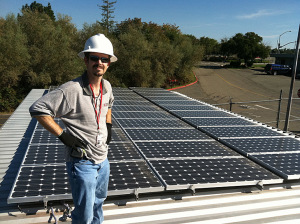
SierraCollege1-300x224Sacramento – Solar power is quickly becoming an economic powerhouse in California, thanks to consistent pro-solar policies adopted at the state and federal levels. According to data contained in a recent report by the Solar Foundation, along with analysis by the California Solar Energy Industries Association (CALSEIA), California’s solar industry now employs more people than the state’s five largest utilities.

“California’s solar industry is turning sunshine into gold in the form of tens of thousands of jobs,” said Bernadette Del Chiaro, executive director of CALSEIA. “We employ over 50,000 Californians with jobs that can’t be outsourced.”

According to a study, California Solar Jobs Census 2014, released last month by the Solar Foundation, California’s solar industry employs 54,690 workers at 3,813 establishments throughout the state. In comparison, the state’s five largest utilities – PG&E, Southern California Edison, LADWP, San Diego Gas & Electric, and SMUD – employ 50,607 workers according to analysis by CALSEIA.
Read complete article here.

Categories : News

Pixley Biogas Project Funded with $4.6 Million Grant

Posted by leephillipsdesign 
· March 9, 2015 

It may have sounded impossibly idealistic at one time, but there’s no longer any debate about whether dairy waste can be converted into low-carbon energy, even on an industrial scale.

Original Article BY JOHN COX, The Bakersfield Californian, jcox@bakersfield.com, Feb 22, 2015

EthanolPlant

Source: Pixley Ethanol Plant by Provided Photo


The question these days is, under what conditions does it make financial sense? A new operation just north of the Kern County border provides a fresh example of what it may take, in terms of logistics, volume requirements and government subsidies, to expand energy production from cow manure.
Calgren Renewable Fuels’s $9.5 million “biodigester” project in Pixley, first fired up last fall, takes in liquid waste by pipeline from an 1,800-cow dairy a mile away. It stores the material in a large tank underground for three weeks at 101 degrees, much the way a cow’s digestive system would. This maximizes the amount of methane it puts off and kills most bacteria and other pathogens. Leftover liquids are then returned to the dairy as fertilizer, while any solids are sent back as cow bedding. Similar recycling processes have been employed at more than 80 biodigesters across the country.What’s left is a gas mixture consisting mostly of methane, the powerful greenhouse gas commonly used to cook food, power vehicles and generate electricity.
The next step is part of what distinguishes the Pixley project from most other “biogas” plants. Calgren uses the gas to help power the company’s adjacent ethanol plant. Other biogas facilities running on dairy waste use the methane to power tractors and other vehicles on site, or they burn it to produce steam to create electricity for sale to the grid. Some plants process the gas and ship it by pipeline to utilities for use as regular natural gas. Besides dairy waste, other materials such as spoiled eggs and waste from meat packing plants can be used as feedstock for the Pixley biodigester.
The biogas produced by Calgren’s digester provides a relatively small amount of the plant’s fuel needs – less than 10 percent. But it’s enough to earn the state’s moral and financial support.

“By reusing dairy waste and converting it to a useful fuel product, we avoid more costly and environmentally risky disposal methods,” Jim McKinney, program manager of the California Energy Commission’s Alternative and Renewable Fuel and Vehicle Technology Program, said in remarks prepared for the plant’s recent opening.

The commission awarded the project a $4.6 million grant funded by a surcharge on California vehicle registration fees that produces about $100 million year for promoting low-carbon fuels.
Find the complete article here: Link

Categories : News

Ryder to Train All of Its Techs on NGVs

Posted by leephillipsdesign 
· March 9, 2015 

More than 6,000 Maintenance and Service Employees Across 800 Facilities

Original Article By Rich Piellisch from fleetsandfuels.com
Ryder_trainingRyder System said this morning that it will train all of its North American maintenance personnel to handle natural gas vehicles – a move affecting more than 6,000 maintenance and service employees across a network of 800 maintenance facilities.

“Now is an appropriate time to ensure Ryder’s technician workforce at every facility is aware of the basic requirements for servicing the new technology,” Ryder Vice maintenance and quality operations VP Melvin Kirk said in a release.”

‘A Proactive Investment’

“More and more of our customers are exploring this advanced fuel solution,” Kirk said. “Ryder is building on its leadership position by making a proactive investment to ensure our maintenance employees are knowledgeable and skilled in the safe operation and maintenance of natural gas vehicles.”

Ryder noted that it has logged more than 30 million miles (F&F,January 29) on natural gas since its first deployment in 2011. The firm now has 14 natural gas vehicle maintenance facilities, and 260 natural gas vehicle trained technicians.
Ryder has deployed NGVs with fleet customers in California, New York, Michigan, Texas, Arizona, Utah, Georgia and Louisiana.

Mostly CNG

About 90% of the Ryder’s NGVs are fueled by compressed natural gas. The company has fielded LNG/liquefied natural gas-fueled trucks in California, Texas, Utah and Georgia.
Ryder says further that since first deploying NGVs in 2011, it “has replaced approximately 4.6 million gallons of diesel fuel with lower emission domestically produced natural gas.”
Complete article here.

Categories : News

FAA Finally Releases Proposed Small UAS Rules

Posted by leephillipsdesign 
· March 9, 2015 

The Federal Aviation Administration (FAA) has released its long-anticipated proposed rules for small unmanned aerial system operations in U.S. national airspace.

by Betsy Lillian for Unmanned Aerial Online unmanned-aerial.com

FAA Finally Releases Proposed Small UAS Rules 1 — Betsy Lillian (February 16, 2015)

UAS must be flown in the daytime, within the visual line of sight (VLOS) of the operator and not above people. Betsy Lillian (February 16, 2015)


Under the proposed regulations, commercial – or non-recreational – UAS must be flown in the daytime, within the visual line of sight (VLOS) of the operator and not above people (excluding those who are part of the operation). The aircraft also must keep below 500 feet in altitude and maintain a speed of under 100 mph. The VLOS rule requires that the operator is “able to see the UAS with unaided vision,” with the optional help of a visual observer (e.g., a first-person-view device), according to an FAA release.“That will do away with all automation for the most part,” Michael Drobac, executive director of the Small UAV Coalition, tells Unmanned Aerial Online. “You can’t use technology if you’re still using people.”Though the proposed rules do not allow for beyond-VLOS operations, the agency is requesting input (during the 60-day public-comment period) on whether or not to allow them and, if so, how to incorporate them.Richard Jost, director at law firm Fennemore Craig and leader of its UAS and aviation practice group, tells UAO that while the proposed regulations are “certainly a positive step forward,” they are “clearly more limited than what most small UAVs are capable of doing today.”

“There are dangerous jobs being done every day that could be done with UAVs,” Drobac explains. He says there were 95 cell tower workers who suffered fatalities on the job from 2012-2014 in the U.S.

Drobac brings up another quandary concerning the proposed rule: that UAS operations cannot take place above people. What happens when an unmanned aircraft is used, for example, to scout out a fire of a building that has residents inside? Would first responders be allowed to fly over them?
“I think there are technicalities that we’ll work through, but we absolutely have to think about this in terms of how the technology can serve consumers,” says Drobac, who adds that he is hopeful the industry can work out these technicalities in the process of finalizing the rule.
“The Small UAV Coalition is now going to be even more aggressive and even more passionate about the cause because now we have something we can work with,” he says.

In order to fly a UAS, the operator, who has to be at least 17 years of age, must receive a UAS operator certificate from the FAA and pass a knowledge test every two years. However, he or she does not need a private pilot license. In the commercial UAS exemptions that the FAA has granted to date (through a Section 333 exemption), the agency has mandated that the pilot and the observer both have an FAA private pilot certificate, among other requirements.

According to Drobac, those requirements should be changed “immediately” in the interim.
Read complete article here.

Categories : News
« Previous Page
Next Page »
Advanced Transportation and Logistics
Copyright © 2026 All Rights Reserved
WCAG 2.0, ATAG 2.0, ADA, & Section 508 Accessibility by UserWay.
Click on Icon in upper right corner or type CTRL+U.